What's new in QuickField 5.9
Release date: November 2011
1. Temperature-dependent electrical conductivity.
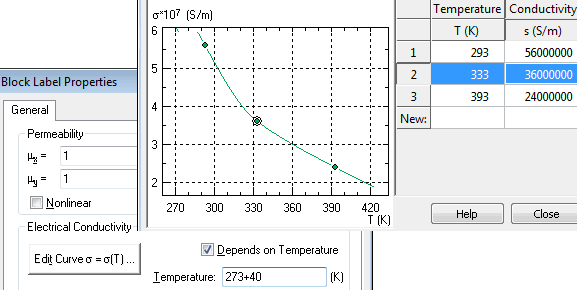
Starting from the version 5.9 QuickField allows taking into account the temperature dependency of the electrical conductivity of each material involved into the DC Conduction, AC Magnetic and Transient Electromagnetic analyses. Following alternatives are now available:
- Electrical conductivity does not depend on temperature;
In this case the conductivity of this specific media should be defined as a constant, exactly the same way as it was in the previous QuickField versions; - Electrical conductivity is temperature dependent, and the temperature in each block is given by a formula with coordinates and time (for transient problems only);
- Electrical conductivity is temperature dependent, and the corresponding temperature field may be imported (to AC magnetic problems only) from the coupled Heat Transfer problem.
2. Magnetic state import into the AC Magnetic analysis.
Magnetic properties of the majority of electrical engineering materials are non-linear. Magnetic permeability depends on the magnetic flux density. Therefore the accurate simulation of magnetic problems often requires many iterations before the series of adjustments of the material parameters and magnetic field distribution stabilize.
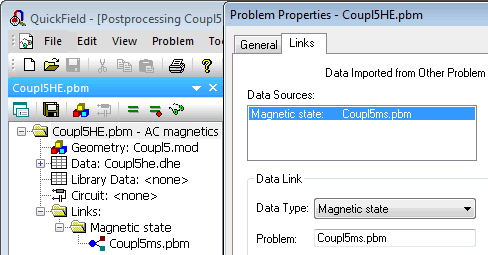
In many practical cases it is possible to combine two magnetic problems, and first calculate the distribution of the materials magnetic properties under the actual operating conditions to be then taken into account in the second simulation, where the detailed simulation of the non-linear material behavior is not important. This approach is implemented in QuickField on the base of problem coupling technology as a Magnetic State import.
Possibility of importing the magnetic state of the non-linear magnetic materials was introduced in the previous release QuickField 5.8, and only for magnetic state import between DC Magnetic problems. QuickField 5.9 extends this approach to AC Magnetic problems, which may now import results of the DC Magnetic field analysis.
Magnetic materials, used in AC Magnetic problem are still considered linear, but the working points are shifted according to the levels of magnetic saturation. This is especially convenient when the source current is a combination of large DC and small AC components and the differential inductances are of interest. Using the magnetic state import technology differential inductances may be calculated using regular Inductance Integral Calculator in AC Magnetic postprocessor.