Natural convection from the horizontal tube surface - QuickField simulation example
Horizontal steel tube, filled with the flowing hot water is surrounded by the still air.
How to find natural convection from horizontal tube surface?
Answer Typical applications Geometry
Given Task Solution Result *Remark: the formulas of the similarity theory give the average value of the convection coefficient. This approach is very approximate by its nature, so there is no reason to make iterations to calculate the accurate Nusselt number related to actual surfaces temperatures.
Engineering question
Set up a plane-parallel QuickField Steady-state Heat Transfer problem for a horizontal tube surface and evaluate natural convection heat transfer from computed field results.
horizontal tubes, cylindrical heat exchangers, external convection cylinders
Download
Simulation problem
Problem Type
Plane-parallel problem of the steady-state heat transfer.
inner diameter of the tube D1 = 120 mm,
outer diameter of the tube D2 = 140 mm,
temperature of the water Twater = 90°C,
temperature of the ambient air Tair = 20°C,
thermal conductivity of the tube λtube = 0.4 W/(m·K)
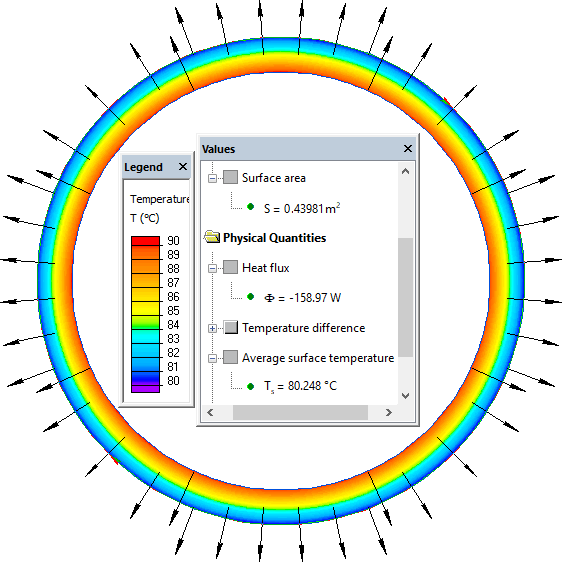
Calculate the temperature of the tube outer surface and the heat flux per meter of the tube length.
Flowing through the tube water heats its internal surface up to the water temperature. Heat from the tube surface dissipates as a result of convection.
We estimate that the temperatures of the tube surfaces is equal to the temperature of the water:
Tsurface = Twater = 90°C.
This value is used for the convection coefficient calculation*:
α = 6 W/(m²·K).
Tube surface temperature: T = 80 °C.
Heat flux per meter of pipe length: f = 159 W.
Related examples