Cylindrical rod - QuickField simulation example
Cylindrical rod is loaded by tensile forces.
How to find stress distribution in cylindrical bars under tension?
Answer Typical applications Geometry
Given
Task
Solution
Volume change can be calculated by the length dL and width dr increments: Results
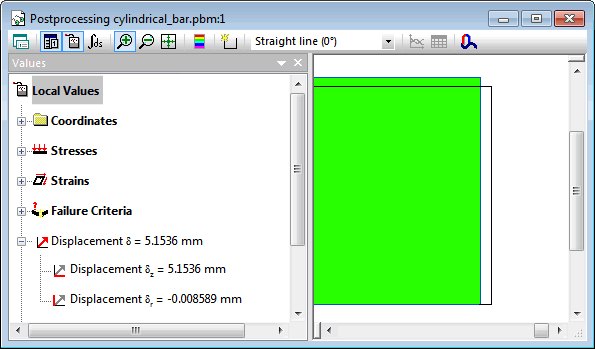
Volume change dV = (3000+5.1536)·π·(15-0.008589)² - 3000·π·15² = 1210.91 mm³.
* James M. Gere, Stephen P. Timoshenko Mechanics of materials, Third edition (1990), pp.26-27. ISBN:0-534-92174-4.
Engineering question
Set up an axisymmetric QuickField Stress Analysis problem for a cylindrical bar under tension and evaluate stress distribution from computed field results.
cylindrical bars under tension, axial load members, structural rod elements
Download
Simulation problem
Problem Type
Axisymmetric problem of stress analysis.
Rod's length L=3000 mm, cross-section diameter d = 30 mm;
Young's modulus of the aluminum alloy E = 70 GPa;
Poisson's coefficient of the aluminum alloy ν = 1/3;
Force P = 85 kN.
Calculate bar elongation, the decrease in diameter and the increase in volume.
One of the rod's ends is fixed. The other end is loaded by the tensile force fz = P / S,
where S= 786·10-6 [m²] - is the rod cross-section area.
dV = (L+dL)·π·(R+dr)² - L·π·R².
Elongation dL, mm
Decrease in diameter 2·dr, mm
Increase in volume dV, mm³
QuickField
5.1536
0.017178
1210.9
Theory*
5.1557
0.017186
1214.8
Error
0.04%
0.05%
0.3%
Video
.
Video
.
Related examples