Ampere's force law - QuickField simulation example
This verification example compares the force of attraction between two thin parallel current-currying wires given by Ampere's law and calculated in QuickField using three formulations: DC magnetics, time harmonics and transient magnetics.
How to find force between parallel current-carrying conductors?
Answer Typical applications Geometry
Given Task Solution According to the Ampere's law* the force of the interaction between two parallel wires is determined as: Results
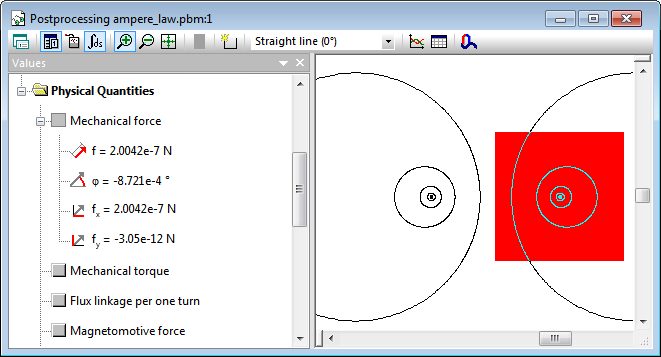
Magnetostatics: f = 2.00·10-7 [N/m]
Time harmonics: f = 2.00·10-7 [N/m]
Engineering question
Set up a plane-parallel QuickField DC Magnetics problem for a parallel conductor arrangement and evaluate force between current-carrying conductors from computed field results.
busbar conductor systems, parallel current-carrying conductors, short-circuit force conditions
Download
Simulation problem
Problem Type
Plane-parallel problem of DC magnetics.
I = 1 A - current of each wire;
f = 50 Hz - frequency in time harmonics and transient magnetics problems;
R = 1 m - distance between the wires.
Calculate interaction force (per meter of length) between two wires and compare with the value given by the Ampere's force law.
Currents are set as linear ones. This way the model completely corresponds to Ampere's formulation.
In the time harmonics problem peak amplitude value of current is set √2·I.
In the transient magnetics current is set via formula I(t) = √2·I · sin(2·180·50·t).
f = 2·(μ0/4π) · I·I / R [N/m]
Ampere's law: f = 2·(μ0/4π) · 1·1/ 1 = 2·10-7 [N/m]
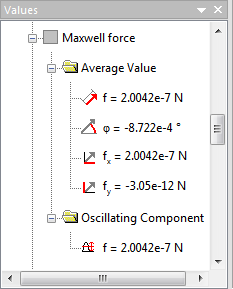
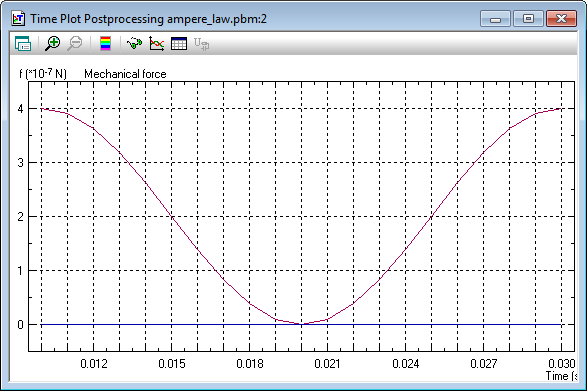
Transient magnetics: time-average force f = 2.00·10-7 [N/m]
Time
Current
Force
0.01 s
2 A
4.0092·10-7 N/m
0.015 s
1 A
2.0046·10-7 N/m
0.02 s
0 A
6.255·10-22 N/m
Video
Related examples